
Affiliate Disclosure: HarvestSense.ai participates in the Amazon Associates Program. If you purchase through our links, we may earn a small commission at no extra cost to you. We only recommend products we genuinely believe in. Privacy Policy.
📋 In This Guide
- The Weight Problem Every Balcony Gardener Runs Into
- Quick Picks by Budget
- Fiberglass vs. Terracotta: The Real Numbers
- What Fiberglass Gets Right — and Where It Compromises
- When Terracotta Is Actually the Smart Choice
- Good/Better/Best: Fiberglass Containers for Small Spaces
- How to Style Fiberglass So It Doesn’t Look Cheap
- One Setup for Every Small Space
- What to Read Next
Affiliate Disclosure: HarvestSense.ai participates in the Amazon Associates Program. If you purchase through our links, we may earn a small commission at no extra cost to you. We only recommend products we genuinely believe in. Privacy Policy.
You don’t fall in love with terracotta because it’s practical. You fall in love with it because it’s beautiful — that warm, sun-baked clay color, the satisfying weight, the way it looks like something from a Tuscan kitchen garden. And then you try to carry a 15-inch terracotta pot up to your sixth-floor balcony and immediately start reconsidering your life choices.
Weight is the defining constraint of balcony gardening, and terracotta fails it badly. A 12-inch terracotta pot weighs 8–12 lbs empty. A 15-inch pot runs 20–40 lbs before you’ve added a single grain of soil. Multiply that across six containers on a 50-square-foot balcony and you’re placing concentrated load on a slab that may have less margin than you think. Add wet soil, and the numbers climb further.
Fiberglass — and its close cousin, the concrete/fiberglass composite blend — solves the weight problem while delivering aesthetics that rival terracotta and ceramic at a fraction of the mass. This guide makes the honest case for when to make the switch, when to keep your terracotta, and which specific containers are worth buying in 2026.
The Weight Problem Every Balcony Gardener Runs Into
Most apartment balconies are built to a minimum live load rating of 40 lbs per square foot — enough to hold people, furniture, and a reasonable amount of stuff. But “reasonable” is doing a lot of work in that sentence. The load rating assumes weight distributed uniformly across the whole surface. A single heavy ceramic planter concentrated near the outer railing creates a very different structural picture than the same weight spread evenly across the slab.
For a practical working limit on a typical apartment balcony, keep your plant and container load to 15 lbs or less per square foot — and do your math with containers fully watered, not empty, because wet soil can double the dry weight of a planting. Our full balcony weight guide walks through the calculation in detail. The short version: terracotta and glazed ceramic make hitting that limit much harder than it needs to be.
The same math applies in RVs, tiny homes, and top-shelf studio setups where weight is a real constraint — not because of structural limits, but because you’re the one moving containers around.
⚡ Quick Picks by Budget
- 🟢 Good — Kante 19.9″ Rectangular Concrete/Fiberglass Planter (~$40)
Matte concrete look at ~5–7 lbs empty. UV-resistant, drainage hole included, available in larger sizes on the same ASIN. Best value entry into weight-conscious container gardening. - 🔵 Better — Kante 28″ Tall Tapered Concrete/Fiberglass Planter (~$91)
Statement-scale planter for balcony corners and entryways. Sculptural tapered silhouette, same lightweight composite formula, 4.5 stars across 510+ reviews. - ⭐ Best — Lechuza Classico Color 43 Self-Watering Planter (~$110)
German-engineered PP resin with sub-irrigation reservoir and water-level indicator. Freeze-thaw safe, 4.5 stars across 5,400+ reviews. The container you buy once and use for a decade.
Fiberglass vs. Terracotta: The Real Numbers
The weight comparison between terracotta and fiberglass isn’t close. A standard 6-inch terracotta pot weighs 2–3 lbs empty. At 12 inches, that climbs to 8–12 lbs. A large 15-inch decorative terracotta runs 20–35 lbs before you’ve added a handful of soil. A substantial glazed ceramic at 18 inches or above can hit 40–60 lbs empty — more than many small suitcases with a weight limit.
The Kante 19.9″ rectangular concrete/fiberglass composite comes in at roughly 5–7 lbs empty. The 28″ tapered model — considerably taller — is in the 8–12 lb range. The Lechuza Classico 43, made from pure high-quality resin, weighs approximately 4–6 lbs. These aren’t rough estimates made to flatter the products; they’re the natural result of replacing dense porous clay with engineered composite materials that achieve the same rigidity at a fraction of the mass.
The soil math matters more than the pot weight
Container weight is only part of the equation. The bigger variable is growing media. Standard potting soil weighs 40–50 lbs per cubic foot when dry, and considerably more when saturated — a 10-gallon pot of wet conventional mix can add 50–70 lbs of soil weight alone. Switch to a coco coir and perlite blend and that same volume drops to 30–40 lbs, a 30–40% reduction that compounds across every container on your balcony. Combine lightweight media with lightweight containers and you’re operating at a completely different weight profile from a traditional terracotta-and-potting-soil setup.
One more variable: the Lechuza Classico’s sub-irrigation system deserves specific mention here. Because the reservoir sits below the root zone and water wicks up as the plant demands it, the soil stays at optimal moisture — not saturated. A freshly drenched conventional container can weigh 30–40% more than the same container between waterings. Sub-irrigation keeps weight predictable.
What Fiberglass Gets Right — and Where It Compromises
Fiberglass and concrete/fiberglass composites aren’t just lighter versions of terracotta. They behave differently in the garden in ways that matter to how you grow.
What fiberglass does well
Weight, obviously — but we’ve covered that. The other advantages are worth naming.
Non-porosity. Terracotta’s clay walls breathe, which means they wick moisture away from the soil — great for succulents and cacti, frustrating for anything that needs consistent moisture. Fiberglass and resin don’t breathe. Soil stays moist longer, which means less frequent watering and more stable growing conditions for herbs, leafy greens, and most flowering plants. The tradeoff: you can overwater more easily. If you’re growing drought-tolerant plants, factor this in.
Durability in freeze-thaw climates. Terracotta is porous. When moisture seeps into those pores and freezes, it expands — and the pot cracks. This is why terracotta is often described as “not frost-proof.” Quality fiberglass (and especially high-grade resin like Lechuza’s) doesn’t absorb water and handles freeze-thaw cycles cleanly. If you’re in a climate with hard winters and you’re leaving containers outside, this matters enormously.
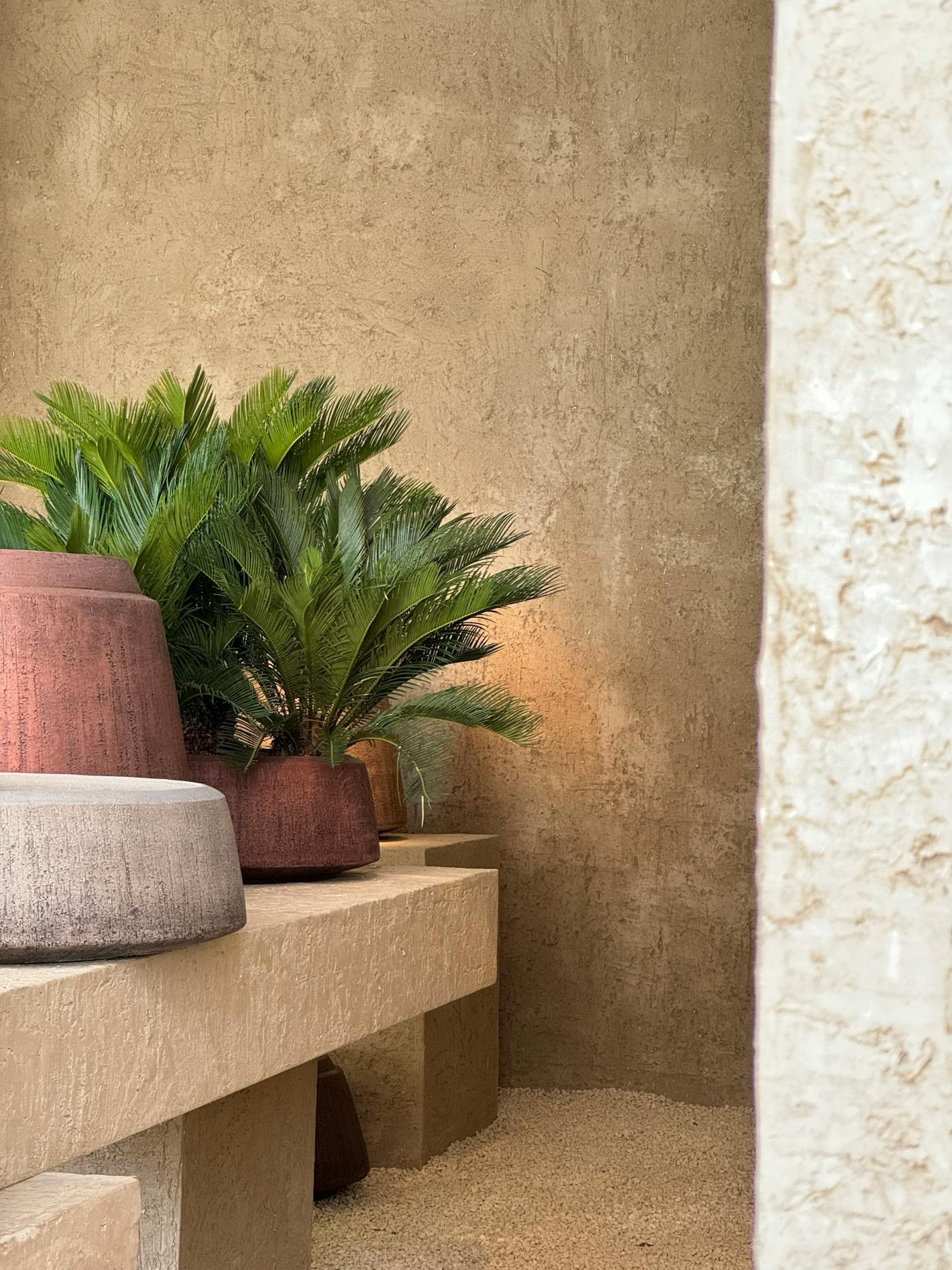
Aesthetic flexibility. Modern fiberglass and composite planters mimic concrete, weathered stone, ceramic, and even terracotta convincingly. From a normal conversational distance, most people can’t distinguish a well-made Kante concrete/fiberglass planter from poured concrete. That opens design options that pure terracotta can’t offer.
Where fiberglass compromises
The concrete/fiberglass blend has durability caveats. Products like the Kante line use a thin concrete coating over a fiberglass core. The result looks great and is genuinely lightweight, but the concrete layer can chip if the pot is dropped or knocked hard. This is a known trade-off: you’re getting the aesthetic of concrete without the structural mass of concrete, which means the surface is more fragile than it appears. Handle with care during moves, and seal if you’re concerned about long-term weathering.
Price premium over basic terracotta. A cheap 12-inch terracotta pot costs $8–15. The Kante 19.9″ starts at $40. You’re paying for material engineering, weight reduction, and aesthetics — but if your budget is tight and weight isn’t a constraint (say, you’re on a ground-floor patio), basic terracotta still does its job.
Lower-grade fiberglass can look cheap. Shiny, thin-walled plastic planters get lumped into “fiberglass” in some marketing, and they genuinely do look like what they are. The products in this guide avoid that problem, but it’s worth knowing the category has a range — matte finishes and textured surfaces are your indicators of quality.
When Terracotta Is Actually the Smart Choice
This is a guide that recommends fiberglass for weight-constrained spaces. It’s not an argument that terracotta is always wrong — and saying so would be dishonest. There are situations where terracotta genuinely outperforms fiberglass, and growers who dismiss it entirely are missing something.
Succulents and cacti
The same porosity that makes terracotta frustrating for moisture-hungry herbs makes it ideal for succulents, cacti, and other drought-tolerant plants. The clay walls actively wick excess moisture away from roots, mimicking the fast-draining conditions these plants evolved in. Overwatering a succulent in a non-porous fiberglass pot is genuinely easy to do. In a terracotta pot, there’s a built-in forgiveness mechanism. For a windowsill collection of succulents or cacti in a studio apartment with no weight constraints, terracotta is a reasonable choice.
Ground-floor patios and low shelves where weight isn’t a factor
If you’re on a ground-floor patio, or you’re placing containers on a shelf or table that’s rated for the weight, the entire fiberglass argument evaporates. In those contexts, the choice is genuinely aesthetic — and terracotta’s warm, organic look is something fiberglass can approximate but not fully replicate. The slight inconsistencies in handmade terracotta, the way it ages and develops a patina, the visual warmth of the clay color — these are real aesthetic qualities that some spaces genuinely call for.
The honest verdict
On a balcony, in an RV, or in any setup where container weight is a constraint: choose fiberglass. For ground-level growing with drought-tolerant plants where you love the look: terracotta is fine. The rest of this guide is for the first group.
Good/Better/Best: Fiberglass Containers for Small Spaces
🟢 Good — Kante 19.9″ H Rectangular Concrete/Fiberglass Planter (~$40)
The Kante 19.9″ is the most accessible entry point into concrete-look containers that won’t put your back out. At roughly $40 and weighing approximately 5–7 lbs empty, it delivers the clean rectangular silhouette and matte concrete finish that reads as modern and considered — without any of the structural drama of real concrete. The composite formula (cement and weather-resistant fiberglass) is UV-resistant, handles most outdoor conditions well, and comes with a drainage hole plus a rubber plug for indoor use. Amazon’s Choice with 897 reviews and 50+ bought last month. Size variants go up to 23.6″ and 27.6″ on the same ASIN — making it easy to step up if you need more height without leaving the product family. Note honestly: the concrete surface can chip if the pot is dropped or takes a hard knock. Handle during moves like you would a ceramic piece. Check price on Amazon
🔵 Better — Kante 28″ Tall Tapered Concrete/Fiberglass Planter (~$91)
Where the 19.9″ rectangular is a workhorse, the 28″ tapered is a statement. The silhouette narrows from a wider base to a slimmer top — a form that gives it sculptural presence without the footprint of a wide planter. At 28 inches tall, it’s substantial enough to anchor a balcony corner, frame a doorway, or give a studio apartment the vertical dimension a few smaller pots can’t achieve. Same cement/fiberglass composite as the rectangular, same UV and weather resistance, same drainage system. Amazon’s Choice with 4.5 stars across 510 reviews — meaningfully better-rated than the rectangular. Worth the jump from the Good tier if you want real design impact, not just practical containers. Check price on Amazon
⭐ Best — Lechuza Classico Color 43 Self-Watering Planter (~$110)
The Lechuza isn’t competing with the Kante products — it’s a fundamentally different category. Where Kante uses a concrete/fiberglass blend that mimics natural materials, Lechuza is pure engineered PP resin, made in Germany to standards that have earned the brand a 20-year reputation in European container horticulture. The practical differences matter: pure resin is genuinely freeze-thaw safe, lighter still than the Kante line, and built around Lechuza’s sub-irrigation system — a self-watering reservoir that sits below the planting liner and wicks moisture up to roots as the plant demands it. The water-level indicator shows you at a glance when to refill, taking the guesswork out of plant care. Sixteen inches wide and about 15.7 inches tall, it’s a compact floor planter that earns its space in any room or on any balcony. 4.5 stars, 5,400+ reviews. This is the container you buy once and use for a decade. Check price on Amazon
How to Style Fiberglass So It Doesn’t Look Cheap
The “cheap plastic planter” look has two causes: shiny surfaces and uniform color. Budget fiberglass and resin containers often come in glossy finishes with flat, uniform tones that catch light in ways real stone and concrete don’t. The products in this guide avoid that problem by design — but it’s worth knowing what to look for and what to do with your containers once they arrive.
Matte always reads as more expensive
Both Kante models use matte, textured concrete finishes that absorb light rather than reflecting it. The Lechuza Classico Color line has a matte surface finish. If you’re ever choosing between a matte and a glossy finish in any fiberglass product, choose matte. The same form factor in a high-gloss finish looks significantly cheaper, even when the price is higher.
Height variation does most of the design work
A collection of containers at the same height looks like inventory. Vary heights deliberately — a 28″ Kante tapered beside a 19.9″ rectangular beside a low Lechuza creates movement and visual interest that no single container can achieve alone. This is the same principle that makes good interior plant styling work: the containers become part of the composition, not just vessels.
One color family, multiple textures
The quickest way to make a collection of fiberglass containers look designed rather than assembled is to restrict your palette while varying the material finish. Charcoal Kante concrete + white Lechuza resin + dark soil and rich green foliage reads as intentional. Three different container colors fighting for attention reads as random. Pick one warm or one cool anchor color and let the plant material provide the visual complexity.
The plants make or break it
A beautiful container with a struggling, leggy, under-lit plant looks worse than a basic pot with a thriving one. If you’re investing in design-forward fiberglass containers, invest equally in giving the plants what they need to look good in them. Right-sized containers, appropriate soil, adequate light. Our Beautiful & Functional Small-Space Indoor Garden Design guide covers the full design framework — pairing container choices with plant selection, light management, and styling principles that work in apartments and small spaces.
One Setup for Every Small Space
The same weight argument lands differently depending on your specific context. Here’s how to think about container choices for three common small-space scenarios.
Apartment balcony
This is the scenario where fiberglass wins most decisively. Start with two Kante 19.9″ rectangulars flanking your balcony door — they frame the entry, add vertical structure, and stay within safe weight limits at roughly 5–7 lbs each empty. Add the 28″ tapered in a corner for visual anchor. Finish with a Lechuza Classico near a window for herbs or a compact flowering plant that benefits from the self-watering system. The total empty weight of this four-container setup is under 35 lbs — less than a single large glazed ceramic planter. Fill with a coco-perlite blend rather than conventional potting mix and you’ve built a genuine design-forward balcony garden within the weight budget of any residential load rating. Cross-reference with our balcony weight guide to run the full calculation for your specific space.
Studio apartment
In a studio, every container is visible from every seat in the apartment. The Lechuza Classico earns its place here more than anywhere else — it’s clean enough to sit on a hardwood floor by a window without looking like a garden supply purchase. One large Lechuza with a statement plant (a fiddle-leaf fig, a Monstera deliciosa, or a large Meyer lemon — see our dwarf Meyer lemon guide) becomes a design element rather than just a container. Supplement with a Kante 19.9″ rectangular near the entry for herbs or a trailing plant. Two well-chosen containers in a studio outperform six ordinary ones every time.
RV and tiny home
Weight matters here for a different reason — not structural load limits, but the reality that you’re the one moving containers when you travel, and that every pound in a rolling home is a pound you carry. The Kante 19.9″ at $40 is the practical pick: lightweight, weather-resistant, compact footprint, and durable enough to survive the occasional jostle. Herb gardens in a pair of 19.9″ rectangulars on an outdoor table work exceptionally well for RV living — easy to water, easy to move. For something that travels inside, the Lechuza’s self-watering reservoir is a genuine advantage: fill before a driving day and the plants manage themselves while you’re in transit.
What to Read Next
Container choice is one piece of a complete small-space garden design. If you’re building out a balcony or indoor garden from scratch, these guides cover the adjacent decisions:
- Beautiful & Functional Small-Space Indoor Garden Design — the full design framework for apartments, studios, and condos: plant selection, styling, and spatial planning
- Apartment Balcony Weight Limits: Your Safe Container Garden Guide (2026) — how to calculate your balcony’s actual load capacity and build within it safely
- Growing Dwarf Meyer Lemons Indoors — container selection, soil, fertilizer, and light for the most rewarding indoor citrus you can grow in a small space
- The 2026 Master Guide to High-Rise Food Security — the full apartment growing framework: systems, crops, light, and a 90-day roadmap
Questions about container choices for your specific space? Use the contact form — I read every message and respond to genuine questions about small-space growing.